
Röbäcksdalen research station
Address
SLU, VPE
Röbäcksdalens fältstation
Verkstadsgatan 15A
SE 904 32 Umeå
Sweden
Station manager
Brooke MickeContact Station
Phone: Contact Station manager to use the facilities:https://www.slu.se/institutioner/vaxtproduktionsekologi/resurser/robacksdalens-faltforskningsstation/
Facilities
Station name and owner
Röbäcksdalen Research Station is a joint collaboration between a field station at the department of Crop Production Ecology and a research dariy farm at the faculty of Veterinary Medicine and Animal Science at the Swedish University of Agricultural Sciences (SLU).
Location
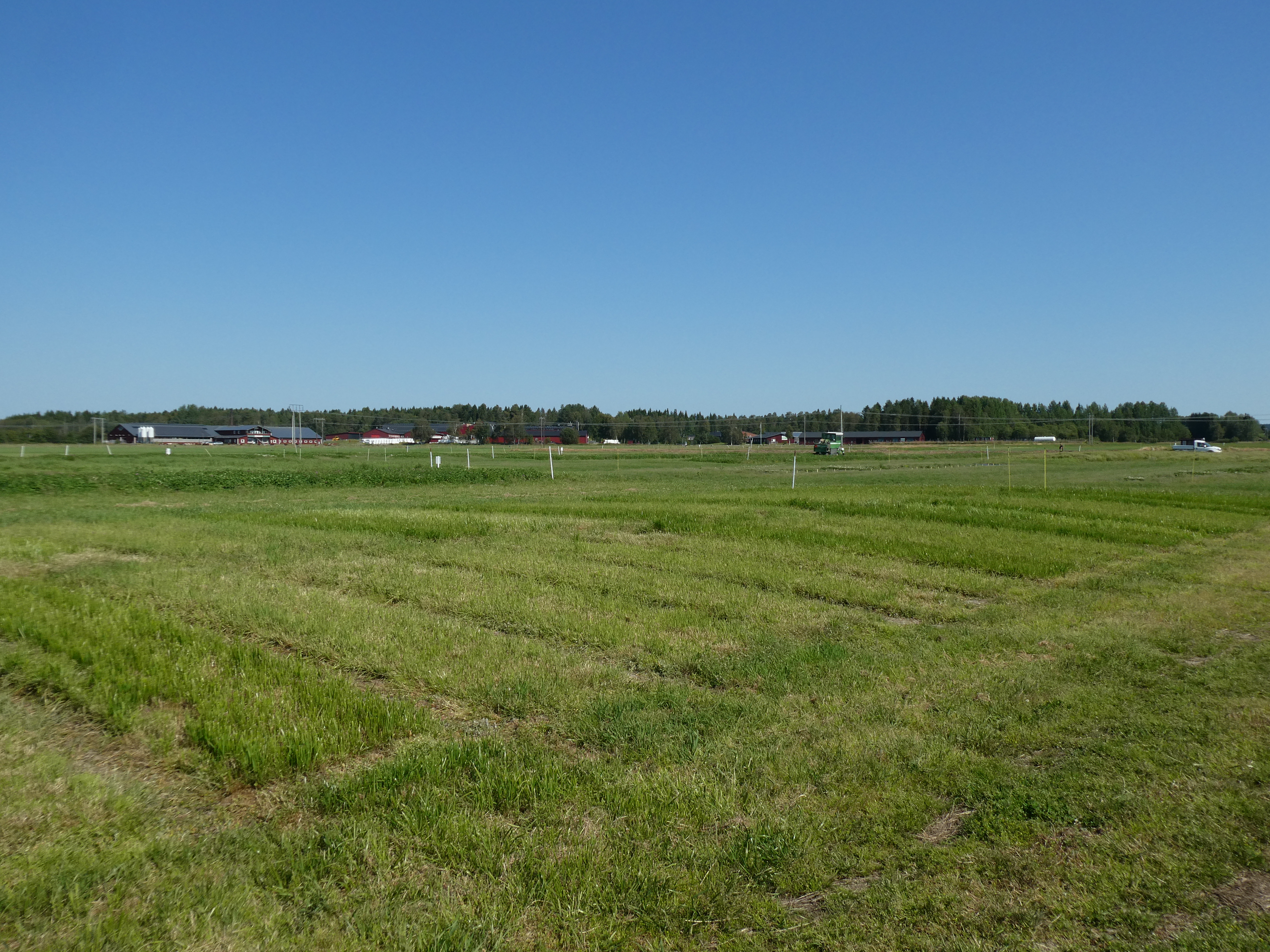
Röbäcksdalen represents a district of Umeå, the largest city in Norrland. Röbäcksslätten, the dominant part of Röbäcksdalen, is the largest continuous agricultural land area in northern Sweden. The station has an urban location around 2 km from Umeå city center.
Climate data
Grey colours are WMO Climate Normals including maximum and minimum values. Blue colours are individual years.
Climate data for the stations where extracted via Copernicus Climate Data Store, from the global gridded reanalysis product:
ERA5 monthly averaged data on single levels from 1940 to present.
Description and source code: Roemer J.K. 2023. https://doi.org/10.5281/zenodo.10214922
Data Source: Hersbach et al. 2023. Copernicus Climate Change Service (C3S) Climate Data Store (CDS), https://doi.org/10.24381/cds.f17050d7
Biodiversity and natural environment
This is an agricultural station with focus on northern Sweden's most common crop rotations. The crops are therefore dominated by leys of grass and clover, and cereals. The addition of dairy cows also means there are pastures around the station, managed both intesively and more extensively. Annual management data about the fields are published through the SITES data portal.The station is a part of a Natura 2000 area, with focus on bird migration, and also of the Vindeln river biosphere reserve. Smaller stands of trees are present at the station, usually as a part of pasture. There are also streams floating thorugh the landscape, which are sampled regularly in a monitoring program called SITES water.
History and facilities
The research station has been around since 1954 and includes a a field station and a dairy research farm. The current dairy barn was build in 2006. The field station manages around 25 ha of land and offers possibilities for small plot experiments, and additional samplings of biomass, soil and water. data is colelcted from a weather station, and througand with additional sampling like weather station, surface water and drainage water. The facilities inlude a sample prepaprtion lab with freezers, cool rooms, drying cabinets, mills and workspace. There is also a spectral lab with different spectral field equipment. The station has around 270 ha of agricultural land.
General research and databases
The station’s infrastructure supports research on a wide range of subjects, e.g. agricultural sciences, animal science, biology, agroecology, soil science, and the environmental implications of agriculture. Röbäcksdalen provides support for field research trials and offers open data on long-term agricultural production, water quality, spectral measurements, and weather. All data that is gathered within the infrastructure can also be made available for researchers. Most of the data is continuously collected and can be accessed through the SITES data portal
Link to data:
Station Monitoring
Human dimension
The urban location of the infrastructure opens up opportunities for interdisciplinary research and other research disciplines outside of natural science.
Access
The station has an urban location around 2 km from Umeå city center. It is easily accessed, with both the city airport and train station located 3 km from the station. By train it's 6,5 hours from Stockholm (and Arlanda Airport), and with flight it's about 1 hour. Nearest local bus stop is around 300m from the station.
